
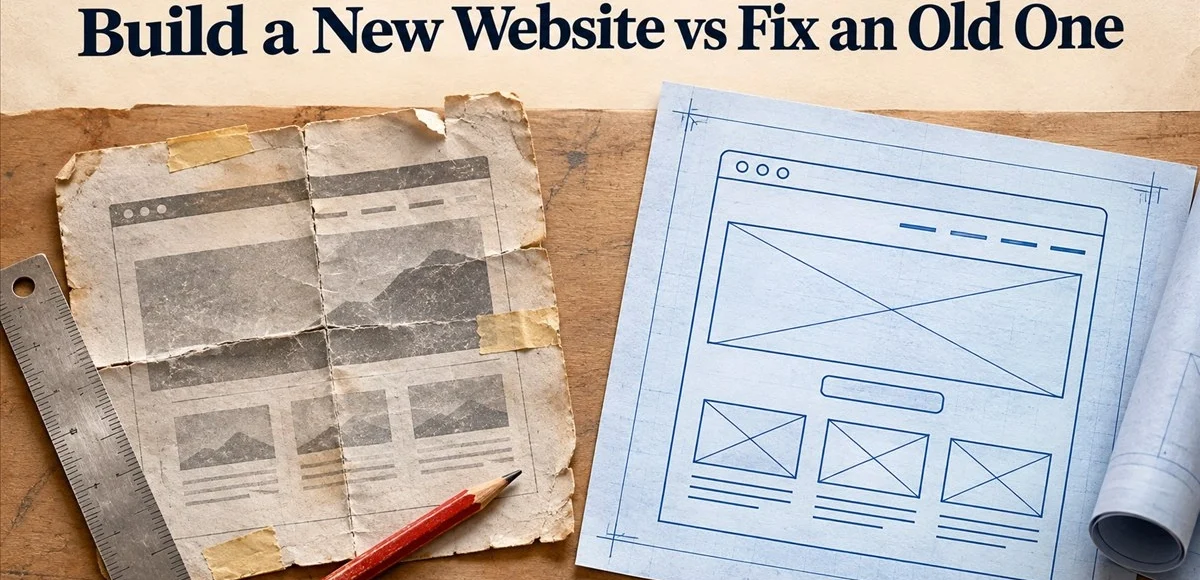
Build a New Website vs. Fix an Old One
Introduction: Website Growth or Website Repair?
Your website is the first impression for customers—and Google. But what happens when it feels outdated or broken? Should you fix existing issues, or start fresh with a new site? This guide explains when to rebuild vs. repair, the SEO impact, and how to future-proof your digital presence.
When Fixing Your Current Website Makes Sense
Updating and repairing your website can be smart if the core is solid. Fixing works best when:
-
Plugins or links are broken but replaceable.
-
Pages are slow but can be optimized.
-
The design only needs a facelift.
-
Content is outdated but easy to refresh.
✅ Best for short-term savings and minor improvements.
When Building a New Website Is Smarter
A complete rebuild is often the better investment when:
-
The site uses outdated technology that can’t be upgraded.
-
The design no longer represents your brand.
-
It isn’t mobile-friendly or SEO-optimized.
-
You want new features your old site can’t support.
💡 A new site improves SEO, user experience, and scalability.
Cost Comparison: Rebuild vs. Repair
-
Fixing: Lower upfront cost, but repeated repairs add up.
-
Rebuilding: Higher initial investment, but long-term savings through efficiency, security, and SEO gains.
Think of it like renovating an old house vs. building new.
Long-Term SEO & Growth Strategy
Ask yourself:
-
Will fixing extend my site’s life by a few years, or just months?
-
Am I investing in short-term survival or long-term growth?
If SEO, mobile usability, and scalability are priorities, a new site usually pays off.
SEO Considerations for Both Options
-
New Site: Fresh architecture, mobile optimization, faster loading, schema markup, and keyword-friendly structure.
-
Fixed Site: Quicker results, preserves backlinks and rankings, but may be harder to scale.
Both approaches can improve SEO—if done strategically.


